Instrument Transformers Information
DATE : 2020-01-03 READ : 2363
Instrument transformers are used to step-down
current or voltage to measurable values. They provide standardized, useable
levels of current or voltage in a variety of power monitoring and measurement
applications.
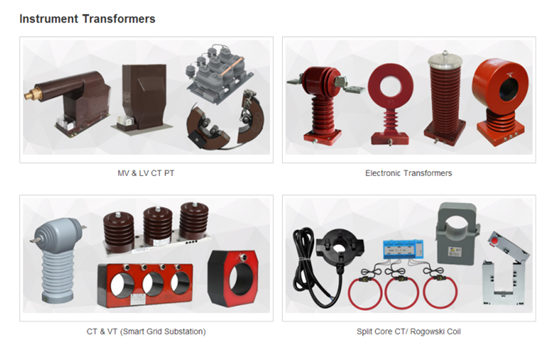
There are two basic types of instrument
transformers:
Current transformers: are used to step-down
current in a predictable fashion with regard to both current and phase. They
are often used as inputs to current-powered instruments.
Voltage transformers: produce a secondary
voltage that is substantially proportional to the primary voltage, but that
differs in phase by an angle that is approximately zero for an appropriate
direction of the connections. Often, voltage transformers are used as potential
transformers or in combination with current transformers.
Some instrument transformers have a waterproof
case or are rated for outdoor use. Others meet U.S. military specifications
(MIL-SPEC) or standards for electric metering from the American National
Standards Institute (ANSI) or the International Electrotechnical Commission
(IEC).
Instrument transformers are used mainly in
measurement and protective equipment. They are also used to provide energy to
protective relays.
Accuracy, the degree to which instrument
transformers produce a current or voltage that is proportional to monitored
value, varies among devices. Highly accurate current transformers are used to
measure turn-on, turn-off and conducting performance in power semiconductor
switches.
Current transformers are also used in the
design of switch-mode power supplies, the development of power electronics, and
lightning simulation tests for surge arrestors.
In addition, current transformers are used in
capacitor discharge surge testing, the development of motor controllers and
electronic variable speed drives, the monitoring of laser tube and diode pulse
currents, current injection, the measurement of harmonics in main power cables,
and in electromagnetic compatibility (EMC) testing.


 Shenzhen Chuangyin Co., Ltd.---- a national high-tech enterprise.
  Chuangyin Activities
  Smart Distribution Solution
  welcome to join us
  Welcome to call the hotline : 0755-86000713